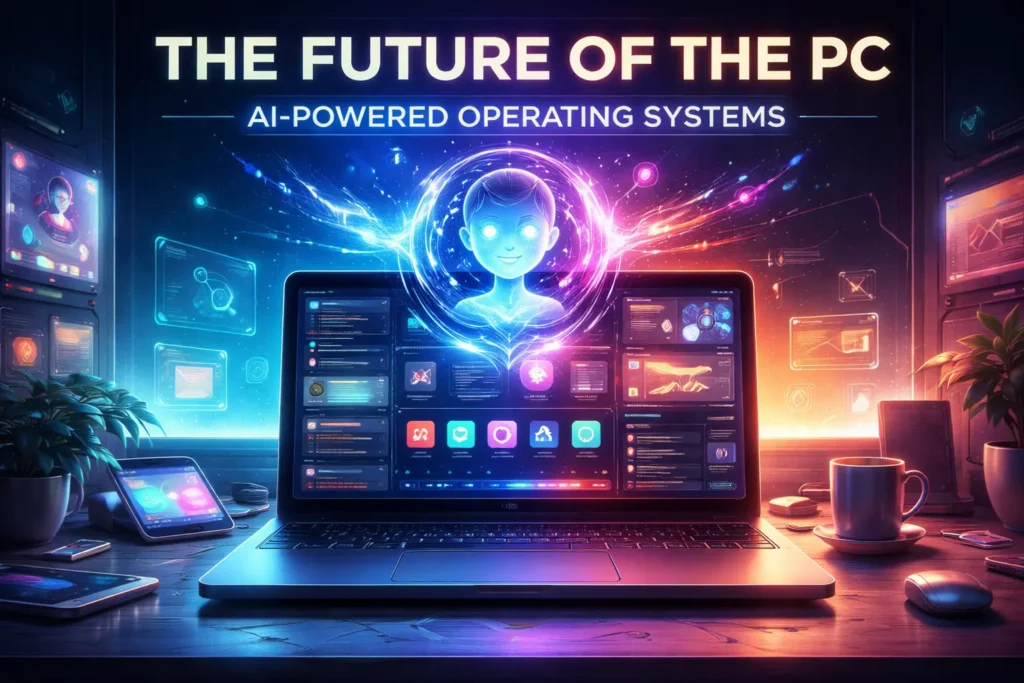
Concept illustration: AI-powered operating systems could reshape how personal computers configure themselves and adapt to user workflows.
For decades, personal computers have followed a predictable pattern. You install an operating system, configure settings, install applications, and slowly shape the machine around your workflow.
It may take weeks or even months before a new computer truly feels like your system.
But emerging developments in artificial intelligence suggest that model may soon flip entirely.
Instead of users configuring their computers over time, the next generation of operating systems may begin configuring themselves from the moment the device boots.
Welcome to the potential era of the agentic operating system.
The Rise of the AI System Agent
In recent years, the technology industry has begun moving beyond simple digital assistants toward something more powerful: AI agents capable of executing multi-step tasks across software environments.
Rather than responding to single commands, these systems can interpret intent, coordinate applications, and automate workflows.
Applied to operating systems, this idea becomes transformative.
Imagine turning on a new computer and being greeted not by a static setup wizard, but by an AI system agent that asks a few simple questions:
- What kind of work do you do most often?
- Do you game or create content?
- Which tools do you rely on daily?
- How private or automated should your system be?
Large technology platforms are already experimenting with similar ideas at the operating system level. Microsoft Copilot, for example, is designed to interact with Windows settings, search the system, and assist with tasks across applications. While today’s implementations are still relatively limited, they hint at the direction operating systems may be heading: AI systems that act less like chatbots and more like system coordinators.
If these capabilities continue to evolve, the operating system itself could eventually become an intelligent layer that manages software, settings, and workflows on behalf of the user.
From there, the system could begin building itself around your answers.
Applications could install automatically, folders could organize themselves around your workflow, and performance settings could adjust to match how you actually use the machine.
Instead of spending weeks shaping a computer, the system could begin shaping itself around you on day one.
Early Examples of AI Agents
The concept of an “AI agent” may sound futuristic, but early versions already exist in today’s software ecosystem.
Several experimental tools allow AI systems to execute multi-step tasks rather than simply answering questions.
Projects such as OpenDevin, OpenClaw, and developer-focused assistants like Claude CoWork demonstrate how AI can plan actions, interact with software tools, and complete workflows with limited human guidance.
These systems can:
- write and modify code
- navigate development environments
- coordinate multiple software tools
- complete tasks that normally require several manual steps
While these tools are still evolving, they illustrate the core idea behind agentic computing: software that can understand goals and carry out actions across applications.
If similar capabilities move deeper into operating systems, computers could eventually automate many routine tasks that users perform manually today.
The End of the Cookie-Cutter PC
Today, two fresh installations of the same operating system look nearly identical. A new Windows machine in Texas behaves almost exactly like one in Berlin or Tokyo.
That consistency has defined personal computing for decades.
An AI-driven operating system could change that.
Once an agent begins learning user behavior, each machine may quickly diverge from the default template.
Different systems might develop:
- unique interface layouts
- custom automation layers
- different file organization systems
- AI-assisted workflows tailored to specific professions
Two computers might share the same hardware and operating system foundation, yet behave completely differently.
In a sense, the personal computer could finally become truly personal.
The Smartphone Precedent
Smartphones have already hinted at this future.
Two devices running the same mobile operating system rarely look the same today. Home screens, widgets, automation routines, and notification systems are all customized by the user.
More importantly, smartphones have become deeply personal devices containing large portions of a person’s digital life.
Many users hesitate to hand their phone to someone else, not because of the hardware itself, but because the device represents their personal digital environment.
Agentic operating systems could bring that level of personalization to traditional PCs.
Why AI PCs Suddenly Matter
This is where the recent push toward so-called AI PCs begins to make more sense.
Chipmakers including Intel, AMD, Qualcomm, Apple, and Nvidia are all racing to build processors with dedicated AI accelerators, commonly referred to as NPUs.
As we explored in our coverage of the 2026 five-way AI PC chip war and the broader platform battle between Nvidia, Apple, Qualcomm, and the x86 ecosystem, the industry is rapidly redesigning PC hardware around on-device AI capabilities.
Those chips are not just meant to run chatbots. They provide the on-device computing power required for operating systems that can observe workflows, predict tasks, and automate actions in real time.
An agentic OS would depend heavily on this kind of hardware.
The system must be able to observe patterns, learn workflows, and automate tasks continuously without sending every interaction to the cloud.
Dedicated AI hardware makes that possible.
Subscription PCs and Cloud Computing
At the same time, another trend is emerging: the idea of the subscription PC.
Cloud computing services are increasingly capable of delivering high-end desktop environments through streaming technology. In theory, a relatively modest device could access powerful remote hardware for gaming, development, or creative workloads.
This model could reduce the need for expensive local machines, replacing them with mid-tier devices connected to powerful cloud infrastructure.
But even in that scenario, the concept of the agentic operating system likely remains intact.
Whether the compute runs locally or remotely, the AI agent that understands the user could remain the central interface.
Your digital environment could follow you between devices, reconstructing your workflows wherever you log in.
The Hybrid Future of Personal Computing
Most likely, the future of computing will land somewhere between purely local and purely cloud models.
Local AI systems could manage personalization, privacy-sensitive tasks, and system-level automation, while cloud platforms handle large-scale computing workloads.
Users might still choose between owning powerful local machines or subscribing to remote computing services.
But the experience of interacting with a personalized AI-driven operating system may remain consistent across both models.
The Next Evolution of the PC
For decades, computers have been tools that users configure manually.
Agentic operating systems suggest a different future: machines that actively evolve around their owners.
Instead of configuring the system yourself, your computer could gradually learn how you work, reorganizing its environment, automating tasks, and optimizing performance over time.
Whether that intelligence runs primarily on your device or partially in the cloud may vary from platform to platform.
But the core idea remains the same: the operating system becomes an adaptive partner rather than a static piece of software.
If that vision takes hold, the phrase personal computer may finally become literal.