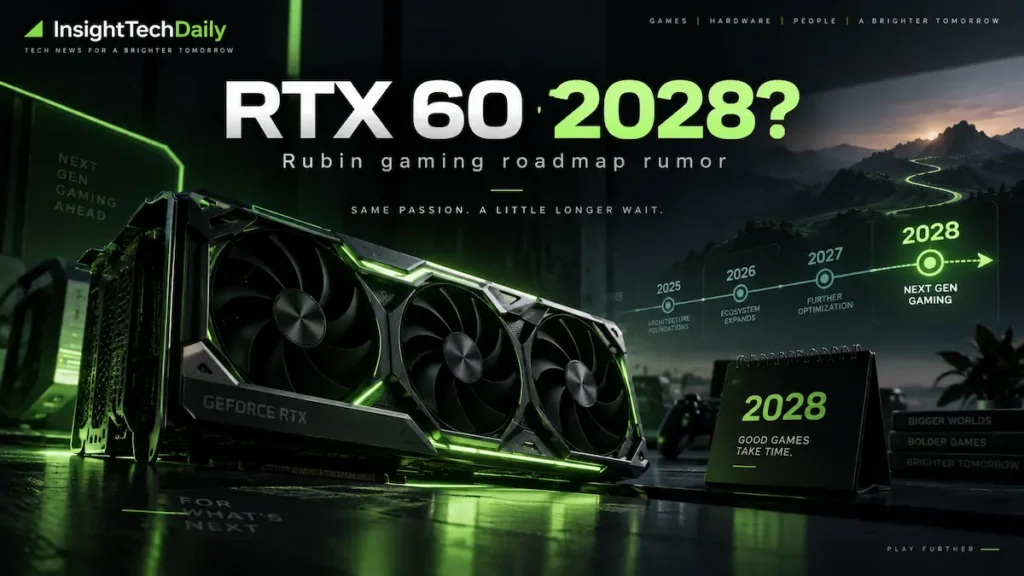
NVIDIA’s next major generation of GeForce gaming GPUs may be farther away than previously expected. Prominent NVIDIA leaker Kopite7kimi now says the company’s GR20x gaming silicon is a 2028 product, backing up a separate report from Kepler_L2 that NVIDIA’s next gaming generation—and much of AMD’s next discrete GPU lineup—has shifted into 2028.
NVIDIA’s GR20x Gaming GPUs Reportedly Move to 2028
The latest report comes from hardware leaker Kopite7kimi, who says NVIDIA’s GR20x family is now scheduled as a 2028 product. That is notable because the same source had previously associated the gaming-oriented Rubin family with a second-half 2027 release window.
“Unfortunately, GR20x is a product from 2028. That means they have postponed again,” Kopite7kimi wrote, while adding that further updates would be limited until more definite information becomes available.
The wording is important. This is a reported internal roadmap change—not an NVIDIA announcement—and there is currently no official release date for a Rubin-based GeForce generation.
Kepler_L2 separately claimed earlier in September that NVIDIA’s next gaming generation had moved to 2028. According to that report, most of AMD’s next discrete GPU family has also shifted into 2028, with only limited new hardware potentially arriving before then.
Having two established hardware leakers point toward the same year gives the report more weight, but it still does not establish a guaranteed launch schedule. GPU roadmaps can change repeatedly before products enter mass production.
GR20x Is Expected to Be NVIDIA’s Gaming Version of Rubin
GR20x is believed to be the designation for NVIDIA’s future gaming GPUs derived from the Rubin architecture. The family is widely expected to eventually underpin what would logically be marketed as the GeForce RTX 60 series.
That branding, however, remains unofficial.
NVIDIA has not announced an RTX 60 series, confirmed GR20x specifications, revealed consumer Rubin GPU models, or published a gaming roadmap extending into 2028. There are also no credible specifications yet for CUDA core counts, memory configurations, power limits, process technology, pricing, or individual products such as a hypothetical RTX 6090 or RTX 6080.
For now, “RTX 60 series” is best understood as shorthand for NVIDIA’s expected post-Blackwell GeForce generation rather than the name of an announced product family.
Rubin Itself Is Already Here—Just Not for GeForce
One detail makes the reported gaming delay particularly interesting: Rubin is no longer merely a future architecture.
NVIDIA officially launched its Vera Rubin platform for AI and data-center computing in early 2026, and the company says Rubin silicon is already in full production. Rubin-based systems are scheduled to reach cloud providers, AI companies, supercomputing installations, and enterprise customers throughout 2026.
The data-center Rubin GPU includes major architectural changes aimed primarily at large-scale AI workloads, including HBM4 memory, enormous memory bandwidth, an updated Transformer Engine, and NVIDIA’s latest NVLink interconnect technology.
Those specifications should not be treated as a preview of a future GeForce card. Consumer GPUs have substantially different requirements involving graphics processing, memory cost, power consumption, die economics, board design, display hardware, and gaming-focused features.
Still, the situation creates an unusual potential gap: NVIDIA’s Rubin architecture could spend well over a year powering some of the world’s most advanced AI systems before a related architecture reaches desktop PC gamers.
A Longer GeForce Generation Than PC Gamers Are Used To
If the 2028 report proves accurate, the practical story may be less about Rubin itself and more about the length of NVIDIA’s current consumer GPU cycle.
A 2028 launch would leave NVIDIA relying on its existing GeForce generation—and potentially refreshed products, pricing changes, or software improvements—for a much longer period before its next major architectural transition.
That would matter because new GPU generations traditionally create several forms of movement in the PC market at once. New flagship cards establish performance targets, lower-tier models gradually move newer architecture into mainstream price brackets, and previous-generation products typically shift position as retailers and board partners adjust inventory.
A longer interval between major generations could slow that process.
It could also increase the importance of software. Technologies such as DLSS, frame generation, neural rendering, driver optimization, and game-specific improvements may carry more of the burden of delivering noticeable upgrades between major hardware releases if the next architecture remains years away.
AMD May Be Facing a Similar Delay
The NVIDIA report becomes more significant because Kepler_L2 claims AMD is dealing with a similar timeline.
Most of AMD’s next-generation discrete graphics lineup is reportedly now targeting 2028 as well, although an AMD GPU referred to as AT2 could still appear earlier.
If both NVIDIA and AMD ultimately hold most of their next major gaming architectures until 2028, the discrete GPU market could go through an unusually quiet period for major generational launches.
That does not necessarily mean GPU development has stopped. Refreshes, new product tiers, mobile GPUs, software features, specialized processors, and individual GPU designs could still arrive between now and then. Neither report establishes that NVIDIA or AMD will release no gaming hardware whatsoever during 2027.
It also would be premature to conclude that the companies intentionally sacrificed gaming products to increase AI accelerator production.
AI infrastructure is unquestionably a major focus for NVIDIA, and the company is already deploying Rubin aggressively in the data center. However, neither NVIDIA nor the leakers behind the current 2028 reports have publicly established AI demand as the specific cause of GR20x’s alleged schedule change.
ITD Insight
The most interesting part of this rumor may be the widening gap between NVIDIA’s enterprise and gaming roadmaps. Rubin is already moving into production AI systems in 2026, while its reported gaming derivative may not reach consumers until 2028. That does not prove NVIDIA is abandoning gaming for AI, but it does show how differently the company can now schedule architectures across markets. For PC builders, the result could be a much longer wait between major GeForce generations than the industry has recently conditioned buyers to expect.
Should You Wait for the RTX 60 Series?
For anyone building or upgrading a PC today, probably not solely because of this report.
A rumored 2028 launch is too distant—and too uncertain—to serve as a useful buying target for someone who needs additional performance now. There are no GR20x benchmarks, prices, power requirements, memory capacities, or confirmed product tiers to compare against hardware currently on sale.
The better question is whether your existing GPU still does what you need it to do.
If it does, a potentially longer generation gives you more reason to keep using it and watch the market rather than upgrading simply because a replacement generation might be around the corner.
If it does not, waiting potentially another year or more for an unannounced architecture could mean spending a considerable amount of time with hardware that already fails to meet your gaming, content-creation, AI, or professional workload requirements.
Homelab and local-AI users should make the same calculation. Available VRAM, software support, power requirements, CUDA or other accelerator compatibility, and current pricing matter far more today than the theoretical capabilities of an unannounced 2028 GPU.
- Reported schedule: Kopite7kimi now places NVIDIA’s GR20x gaming family in 2028 after previously pointing toward the second half of 2027.
- Second source: Kepler_L2 has also indicated that NVIDIA’s next gaming generation and most of AMD’s next discrete GPU lineup are targeting 2028.
- Official status: NVIDIA has not announced an RTX 60 series, consumer Rubin specifications, or a GeForce Rubin release date.
- Rubin today: NVIDIA’s data-center Rubin platform is already in production, but its specifications should not be assumed to carry directly into consumer GeForce products.
- Buying advice: Choose current hardware based on the performance, VRAM, features, power consumption, and price you need now—not projected specifications for a product generation that remains unannounced.
Bottom Line
The evidence for a later NVIDIA gaming roadmap is beginning to line up. Kopite7kimi now says GR20x has moved from a previously reported second-half 2027 window into 2028, while Kepler_L2 has separately pointed toward the same year for NVIDIA’s next gaming generation and much of AMD’s next discrete GPU lineup.
That makes 2028 a credible reported target, but not a confirmed GeForce launch date.
The more important takeaway for PC builders is that the current GPU cycle could last considerably longer than expected. NVIDIA’s Rubin architecture is already entering the data center, yet its rumored gaming counterpart may remain years away. Until NVIDIA officially reveals its next GeForce roadmap, there is little reason to base a current purchasing decision on hypothetical RTX 60 performance or pricing.