Meta is a lead customer for AMD’s 6th Gen EPYC “Venice” processors as the companies expand their collaboration across CPUs, Instinct GPUs, Helios rack-scale systems and AI software. The partnership combines existing infrastructure deployments with joint development of future platforms, including EPYC “Verano.”
AMD EPYC Venice Builds on Meta’s Existing CPU Deployments
Meta has deployed millions of AMD EPYC processors across multiple generations. Venice extends that relationship, but the installed total should not be confused with shipments of the new CPU generation.
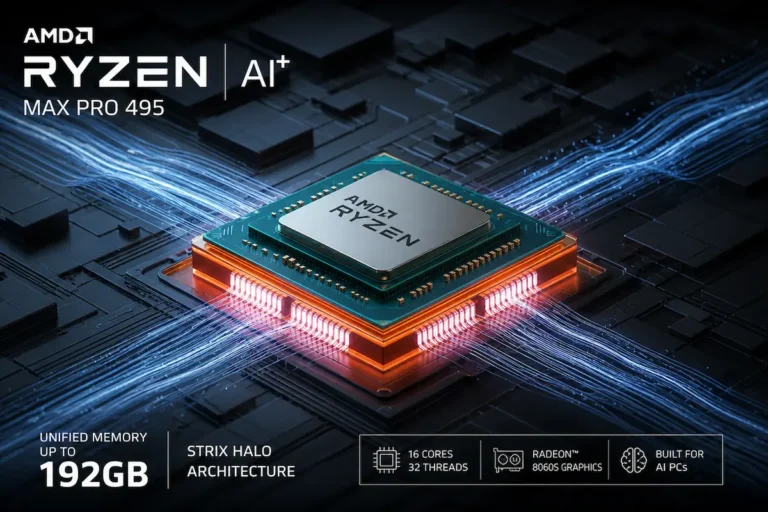
AMD identifies Venice as a 6th Gen EPYC processor based on its Zen 6 architecture. The company announced its production ramp on TSMC’s 2nm process in May 2026, positioning it for cloud, enterprise and AI infrastructure.
Why CPUs Matter Alongside AI Accelerators
In its July infrastructure update, AMD described an expanding CPU role in agentic AI: coordinating agents, executing tools, running code and managing data around the models themselves.
That gives Venice a role beyond conventional server consolidation. Its relevance to Meta includes the supporting work surrounding GPU computation. Whether a particular deployment improves utilization or operating costs, however, requires workload-specific measurements.
Helios Moves the Partnership Beyond Individual Components
AMD’s October 27 partnership update says initial Helios rack-scale systems are installed and being tested at Meta ahead of broader deployment. AMD also says EPYC processors support the computing environments behind Meta’s Muse personal AI agent.
Helios brings together Instinct GPUs, EPYC CPUs, Pensando networking and ROCm software. AMD describes the collaboration as joint engineering across compute, memory, networking, power, cooling and software.
The deployment stage matters: initial installation and testing demonstrate progress, while the scale and performance of a broader rollout remain separate questions.
Meta’s Hardware Diversity Strategy Requires Software Co-Design
Meta’s research on hardware diversity describes a fleet that includes NVIDIA GPUs, AMD GPUs and its own MTIA accelerators. The stated goals include reducing costs and limiting vendor lock-in.
The paper also identifies a practical obstacle: years of NVIDIA-specific optimization make performance harder to transfer directly to other hardware. Meta’s approach includes adapting model structures, selecting kernels for particular workloads and optimizing software for the target accelerator.
What the MI350X Training Results Actually Show
In its recommendation-model training case study, Meta highlights the Instinct MI350X’s 1.6 times greater high-bandwidth memory capacity relative to NVIDIA B200. Separately, the researchers report up to a 1.5 times improvement in end-to-end training throughput after their optimizations, compared with a directly ported baseline.
These figures answer different questions. The memory ratio compares hardware capacity; the throughput gain measures the benefit of the optimization work. Combining them into a general claim that MI350X trains models 1.5 times faster than B200 would misstate the findings.
Muse Spark Open Shows the Impact of Inference Optimization
AMD’s Muse Spark Open technical article provides a separate example focused on inference. The model has 816 billion total parameters, 42 billion active parameters per token and a context window of up to one million tokens.
AMD reports the following results for its MXFP4 configuration on an eight-GPU MI350X node:
- Four concurrent requests: decode-step optimizations increased aggregate output throughput from 206 to 350 tokens per second.
- 32 concurrent requests: the same optimization work increased aggregate output throughput from 719 to 1,180 tokens per second.
- Higher concurrency: expert parallelism added a reported 7–20% throughput improvement at 32–128 concurrent requests.
- Single-stream generation: DSpark speculative decoding reached a reported 199 tokens per second.
These are AMD-reported results for particular software configurations. Aggregate throughput across concurrent requests should not be read as the generation speed experienced by each user, and the figures do not establish performance relative to competing GPUs.
Verano Extends the EPYC Roadmap
AMD and Meta are also collaborating on future EPYC generations, including Verano. AMD’s May roadmap update describes Verano as a 6th Gen EPYC processor intended for cloud and AI workloads, with planned LPDDR memory integration and an emphasis on performance, bandwidth and power efficiency.
Those disclosures establish a product direction. They do not, by themselves, establish how Verano will perform in Meta’s production workloads or how its operating costs will compare with alternatives.
ITD Insight
Our assessment: the strongest evidence here is the combination of deployed hardware and workload-specific software engineering. Venice, Helios and Verano address different parts of Meta’s infrastructure strategy, while the MI350X research shows how much optimization can influence the outcome. For other infrastructure buyers, the useful comparison is complete workload performance, response latency, power consumption and integration effort.